

Tech Quarterly: Alpine Eagle’s Sentinel C-UAS
- Tech Quarterly
- Tech

Alpine Eagle has been selected to feature in the second edition of DSEI Gateway's Tech Quarterly series, for its C-UAS platform ‘Sentinel’.
Founded in July 2023 by co-founders Jan-Hendrik Boelens and Timo Breuer following the defence sector's shift towards drone warfare, Alpine Eagle has quickly established itself in the counter-UAS (C-UAS) space.
It’s the brainchild of two executives with strong defence expertise – Boelens has held positions as a chief engineer at Airbus and as the chief technology officer for defence tech company Quantum Systems, while Breuer has held military science roles at the likes of Fraunhofer-Gesellschaft and Microsoft Research.
Following its establishment, the company has worked primarily on ‘Sentinel’, Alpine Eagle’s flagship aerial-based C-UAS platform, equipped with radar, electro optical sensors, AI software, and an air-to-air interceptor to detect and intercept hostile drones and loitering munitions.
“We kind of saw that the whole defence ecosystem was shifting towards a focus on UAS and drones – they’re redefining the battlefield. So, what's the next step? Well, if everything is shifting towards drones, then you need a solution to defeat drones”, Benji Pauly, Business Development Manager at Alpine Eagle, told DSEI Gateway.
The company looked at existing solutions and found them to be lacking. Radar, for example, can be ineffective as it can detect more data than is necessary, Pauly said, adding that it picks up “all the noise and clutter”. These sensors can also be limited by the physical surrounding environment.
“So, we thought, okay, why don't we put a radar on a drone? Then, all of a sudden, from having a semi-permanent installation that's limited by your terrain, you’re able to put it where you need it”, Pauly said.
A key enabler of this approach, and a core component of Sentinel, is the integration of the company's AI software into the radar. This software, Pauly emphasised, filters out radar clutter at the edge, allowing “confident detections” to be displayed to the operator without the need for real-time processing or filtering.
Along with this, Sentinel is integrated with the company’s custom ground control software called Eagle Watch, which supports mission planning as well as controlling the radar and detection functions.
In addition to detecting threats, Sentinel is equipped with an air-to-air interceptor called Sparrowhawk, developed entirely in-house, that can take out adversary drones. Mounted on Sentinel in a “marsupial” configuration, the effector can be “loitered until it is needed”.
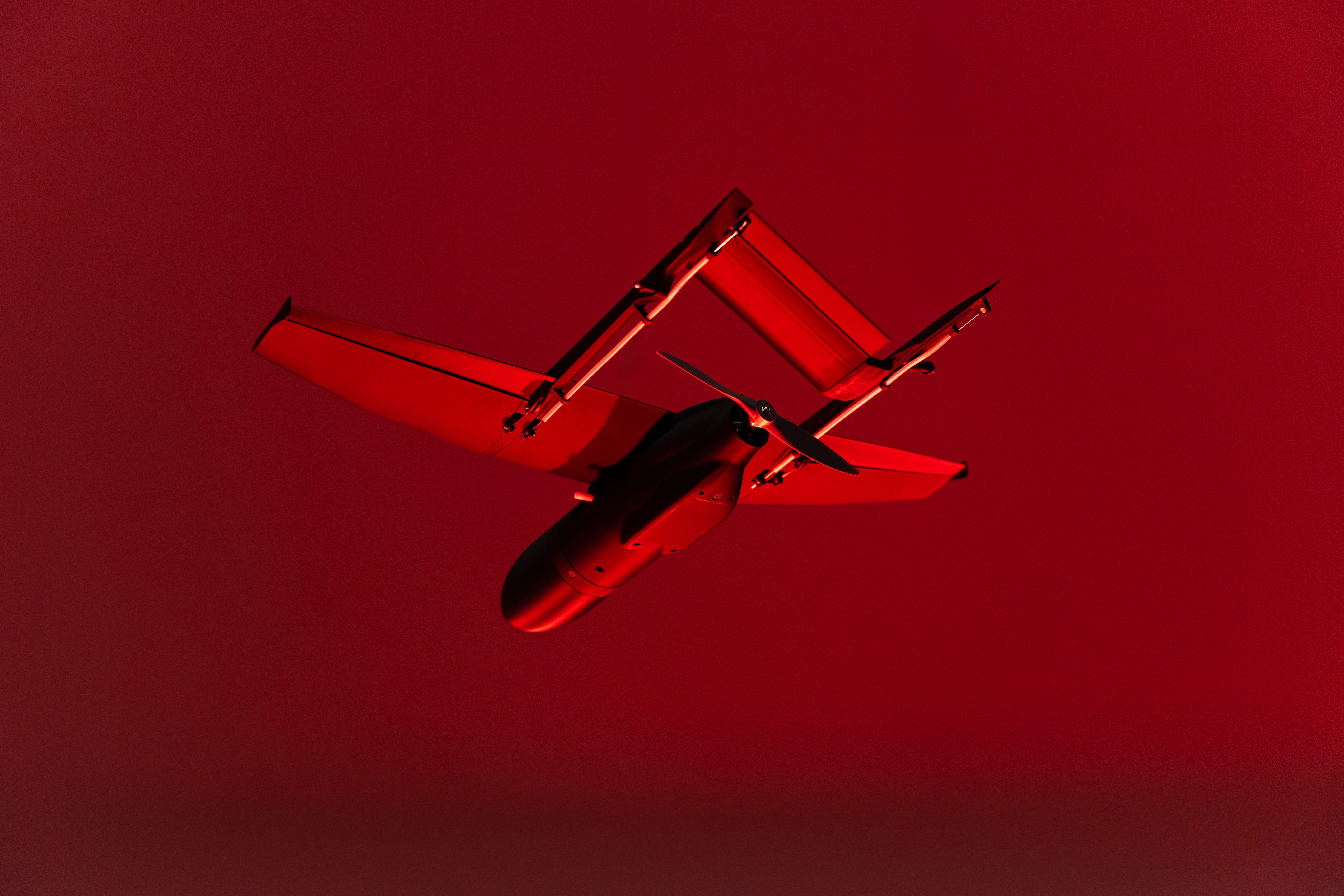
Alpine Eagle's Sentinel C-UAS equipped with the company's Sparrowhawk air-to-air effector. (Alpine Eagle)
It is this combination of the airborne C-UAS platform and the company’s software stack that makes Alpine Eagle’s system distinctive, Pauly said.
“You're able to detect drones at any location that you want. You can take off from 50km away, fly it ahead of the forward line of troops, and detect a wide range of assets. We can then give you a very precise coordinate of what that is, we can follow the target or just make you aware, and then you can choose how to defeat it”, Pauly explained, noting that users can choose to use it to defeat or just detect adversary drones.
By being fully Sapient compliant, the platform can also integrate into wider C-UAS networks and pass on detections to battle management systems with minimal setup, he said.
Progress and trials
Since its launch, the company has gone from strength to strength, having had its first trials with the Bundeswehr (German Armed Forces) in October 2024. By November it was delivering units to them, which it continues to do today.
While Pauly was limited on what he could say regarding the trial, he did note that Sentinel was put through its paces, proving that it was capable of detecting UAS threats, including below 5kg, within a 4km range.
It also participated in ‘Project Vanaheim’, a collaborative effort between the UK and the US launched in early 2025 to develop and improve C-UAS solutions for both militaries in a high-pressure combat like environment.
Multiple systems were evaluated in the simulated battlefield environment, with red and blue teams representing adversary and friendly forces. Alpine Eagle operated across both offensive and defensive lanes, Pauly said.
“Beyond demonstrating current capabilities, participation in Vanaheim gave Alpine Eagle access to a training scenario of unmatched realism. The exercise exposed operational data and workflow stress points that laboratory or field testing typically fails to replicate.”
The company has also been conducting regular operational trials in Ukraine since last year, with the system demonstrating its ability to operate in contested electromagnetic environments through the use of Silvus mesh radios. The system has also been tested against high-altitude intelligence-gathering drones, successfully detecting and tracking these targets despite their altitude and the presence of electronic countermeasures.
Off the back of its activities, the company has quickly expanded, establishing offices across Europe, including in Germany, the Netherlands, and the UK to “rapidly meet criteria”, Pauly emphasised.
One area the company is expanding into is the protection of critical infrastructure, such as airports and stadiums. Although, the company has identified challenges in this capacity. The current regulatory landscape has been a “bit of a blocker”, Pauly said, with requirements and permissions needing to be met regarding existing radar infrastructure.
“But if you see what's happening all over Europe now, with drones appearing [in] places they shouldn't, that's quickly changing, and we hope that enables us to start reaching those types of clients.”
Looking ahead, Pauly added that the company plans on developing its Sentinel product to improve its interception capability, by finding different ways to launch the interceptor to accommodate different use cases.
The company is also looking to increase flight time and payload capacity, allowing it to accommodate more radars, and potentially optical sensors to improve the range of data end users can access.
Pauly was also keen to stress the company’s European credentials as part of Alpine Eagle’s focus going forward.
“If there's one takeaway, we're a very European company, that's what we're proud of. We want to be a European defence company with European made hardware to help in the next and future wars of Europe”, Pauly said.
)
)